


WRITTEN BY
VICTORIA MEDGYESI PHOTOGRAPHED BY BENJAMIN BENSCHNEIDER
LA DOLCE CONTEMPORANEO
On
Mercer Island, two Italian architects create the good life on the
family compound
 |
 |
| |
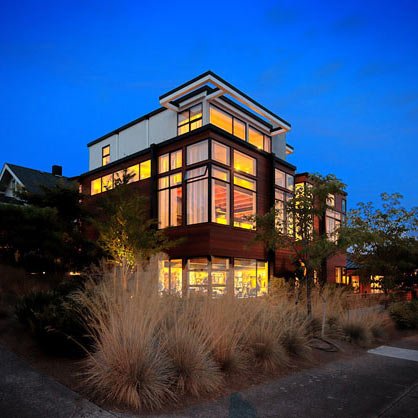
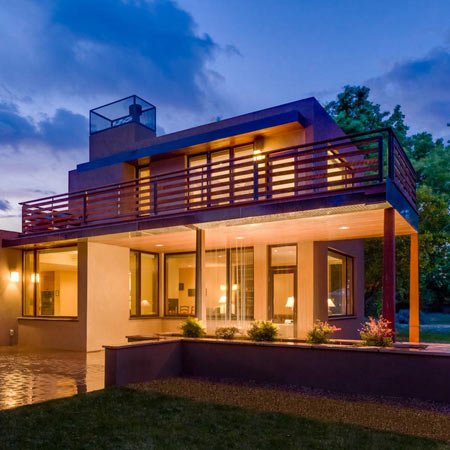
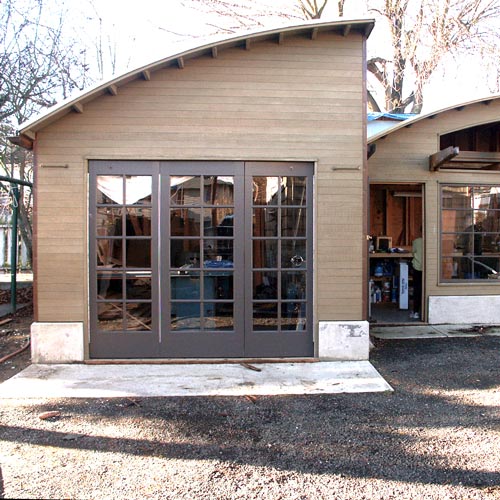
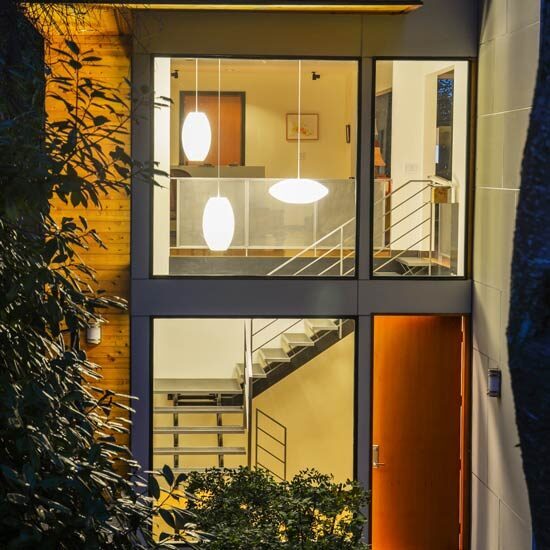
AT NIGHT, the home of architects Lucia Pirzio-Biroli and
Michele Marquardi glows. In the summer, the gravel-filled courtyard is an
outdoor room; in winter, a source of interior light. The double doors were
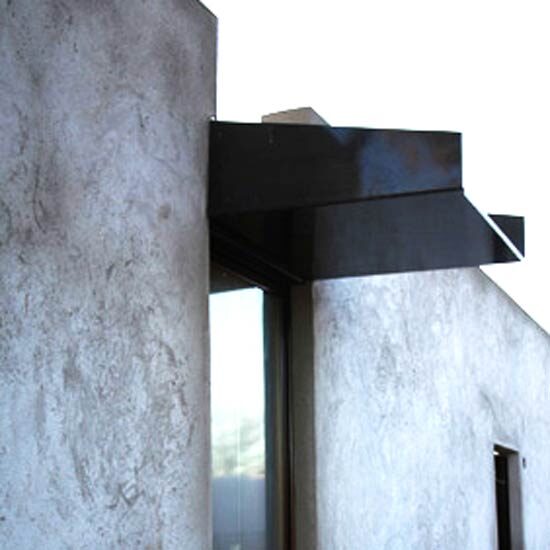
salvaged from a Frank Lloyd Wright house demolition. The exterior is black
asphalt shingle (typically used for roofing) with contrasting panels of
integral-color, cement-based stucco. The Owen Roberts Group was the general
contractor; the couple, here with dogs Zeus and Della Street, did much of the
finish work. |
| |
 |
LIKE MANY, I romanticize the daily Italian way of being.
I envision leisurely lunches of fresh mozzarella and
vine-ripened tomatoes, wine from the local vineyard, olives from a neighbor's
grove. In my mind, it's a peaceful life lived on land that's been in the family
for generations. Surely, no one works. They're too busy making beautiful food,
beautiful homes, beautiful babies.
Inspired by films, books, magazine articles and memories
of personal trips, many of us dream about how gracious life could be . . . if
only we were there. While life and homes in Italy are indeed
wonderful, architects Lucia Pirzio-Biroli and Michele Marquardi are proof that
wonderful isn't necessarily about a specific place. Rather, it's about taking
the time to thoughtfully define how you want to live. It's also about taking
grateful advantage of the gifts of dual culture and family support.
Without a doubt, the couple has put a great deal of
thought into how they approach life, build their careers and stay connected to
community. Today, that process has manifested itself in a graciously compact
home and professional studio space built on land that's been in Pirzio-Biroli's
family since 1954.
Back then, the roads on Mercer Island were dirt and deer
outnumbered people. Since that time, much has happened on the island and on the
acre site: Over 15 years, the family built a home, a home in which
Pirzio-Biroli's mother still lives. Her brother and his family have a place on
the other side of the property. The third and newest addition sits in the
center of it all. (Or, as Pirzio-Biroli likes to joke: "We built a house right
in my mother's driveway.")
From early on, Pirzio-Biroli was encouraged to think
about science (her father was a physician) as well as art and natural beauty
(her mother is an art historian and a botanist). In 1989, Pirzio-Biroli took a
break from graduate school to work at an architecture firm in Italy. While
there, she met Marquardi, who grew up in the same place her father had grown up
in the Friuli region northeast of Venice. "The grappa capitol of the
world," Marquardi says with a laugh.
|
|
| FROM THE FRANK LLOYD WRIGHT doors looking in, the main space
opens up. The integral-color concrete floors are heated. The painting on the
eggplant-color wall is of Pirzio-Biroli's grandmother; the bronze sculpture
study (far corner) by Theodore Roszak. In the foreground: a black leather day
bed by Zannotta (at Inform), the Reflecting Bench by John Wells (at Objex). On
the floor is a hand-spun, hand-woven Persian tribal rug (from Driscoll
Robbins). |
 |
 |
| BY DESIGN, each area of the home has simple, rugged finishes.
This view is from the living area into the kitchen. The painting over the day
bed is by artist David Chell. |
 |
It was a personal, professional and philosophical
match.
The couple stayed in Italy, working together on
residential projects and design competitions. In 1994, they moved to Mercer
Island where Studio Ectypos, the couple's architectural design firm, was
formed.
At first, building a practice took priority over
building a home. As a result, the couple lived in her parents' house until last
year. Given the amount of time they had to plan their own space, they were
careful not to "over-think" the layout. "When a house is too programmed, it
diminishes its spontaneity," says Marquardi. "We believe in simple, open spaces
that naturally lead you from one place to another."
To that end, the pair made sure each area of the
1,800-square-foot, two-level layout could be used in several ways. For
instance, the hallway doubles as a media/reading room, the studio houses their
personal library and the courtyard is a second living room in the summer. By
intention, each of the two bedrooms is on the small side.
They also spent significant time thinking about the
philosophical underpinnings of the home. This included choosing a name for the
project that would express their design intentions. They decided on "Firmitas"
(or solidarity), one of the three principles of architecture as defined by the
ancient Roman architect Vitruvius. "Our house is solid, it tells it like it is,
there are no hidden messages and yet somehow that is where the magic is," says
Pirzio-Biroli. "It is simple, authentic, compact and fun."
The couple believes their connection to the archaic
architecture of Europe and to Mercer Island was critical to the final outcome.
"Even though this is a new house, it has a history in the site, in the form,"
Pirzio-Biroli says.
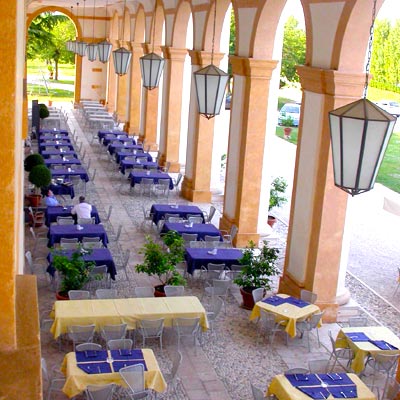
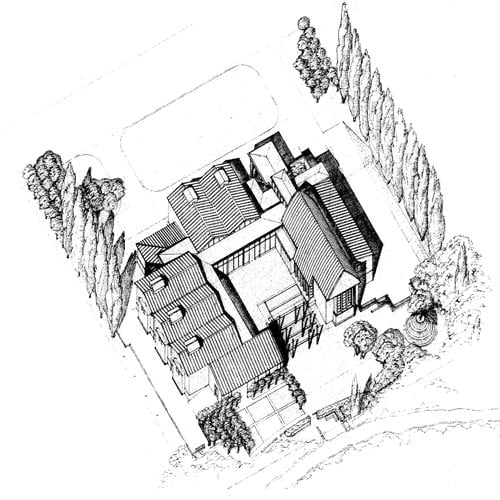
At its most basic, their home is organized around a
traditional courtyard space similar to those found in the farm houses of
Friuli. "The relationship and scale of the spaces are similar, but the language
in which the story is told is contemporary," she says. "We used details that
reflect the intent of those old farm houses, but we expressed them in an
entirely different language."
|
|
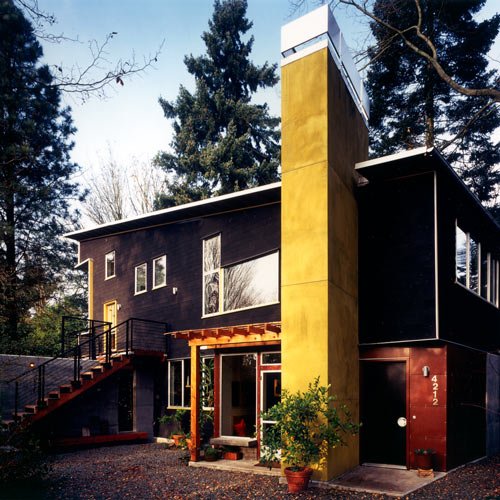
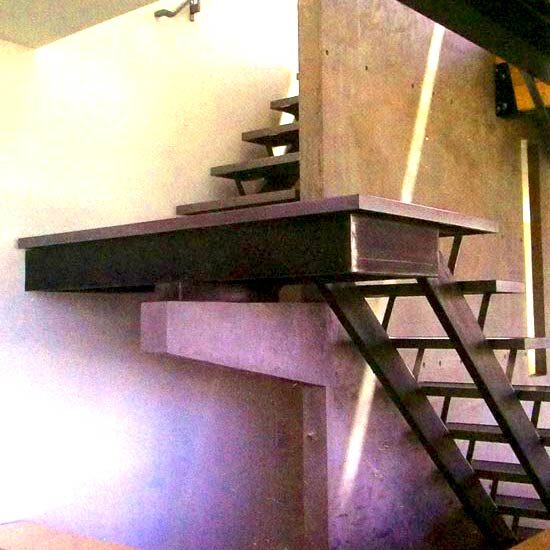
| DURING THE DAY, light filters through the wood slats of the
exterior stairway, which does double-duty as a courtyard wall. Following the
European tradition, the first few risers were built of stone to discourage
rot. |
 |
That "different language" is apparent in the mix of
traditional and nontraditional materials: Massive concrete walls and a
cement-based stucco chimney interact comfortably with more transient materials
such as wood decking, black asphalt shingles and composition cement board.
One of the biggest challenges was protecting the
surrounding landscape. For more than 45 years, Pirzio-Biroli's mother nurtured
a garden densely packed with rare specimens. In the end, only two trees had to
be removed, both of which were unhealthy. Several large rhododendrons and one
Japanese pine were relocated. "The house needed to be on par with the garden,
not overwhelm it," says Pirzio-Biroli.
Most importantly, the couple wanted a home (and a
professional studio) that was approachable. "Socially, coming here has been a
little surprising," says Marquardi. "In Italy, we have a tendency to ring the
doorbell and visit somebody. Here, it's like setting an appointment. You say,
'In three weeks, we'll get together.' I like people to just stop by."
To help create a contemporary, informal interior that
would support their drop-by intentions, the pair consulted with Seattle's Vivid
Design Group on furniture and art placement. The Vivid team also helped them
set priorities for future purchases. During the process, one of the firm's
principals, Kris von Oy, died in an accident. Given the couple's close
friendship with von Oy, the sudden loss reinforced their commitment to live
each day to the fullest.
As could be expected, the pair brings this intensity and
sense of purpose to each project they accept. Still, it would be a mistake to
think they don't have a sense of humor about the whole thing.
Take, for instance, their building-permit story. When
chided by a city employee for not maximizing the value of their lot by building
a mega-house with a master suite, walk-in closet and luxurious bath (an opinion
apparently shared by the appraiser who took points off their construction loan
for the same reason), they were far from displeased.
 |
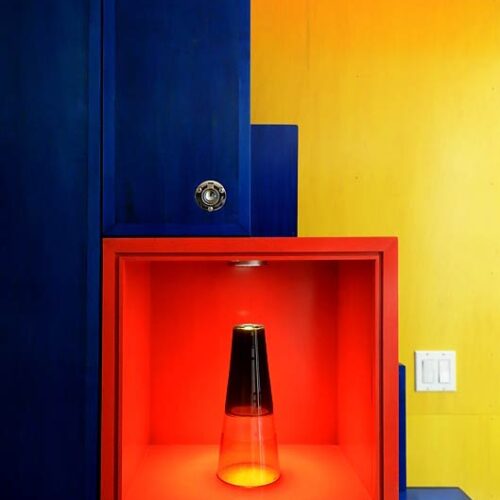
| WHEN IS A HALL not just a hall? When it's used to house the
television, the ironing board (behind the blue door) and art, as well as act as
a passageway from the bedrooms to the office studio. The
pigmented-stain-on-wood form was inspired by painter Piet Mondrian (executed by
Ahrenius Manufacturing). Art on the ledge: to the left, a print by Valery
McEvoy; in the center, an engraving by Italian artist G.B. Piranesi; on the
right, an antique Japanese print, artist unknown. |
|
 |
 |
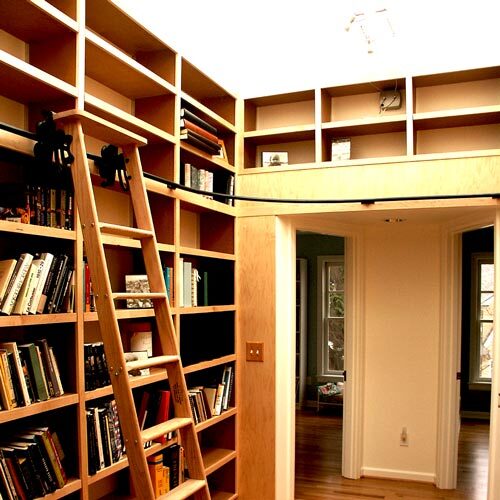
| THE SPACIOUS STUDIO soars to 14 feet at its highest point, and
looks out over both the front and back garden. The 120 linear feet of bookcase
(as well as all office casework) was built by Ahrenius Manufacturing. Overhead,
a small loft overlooks the studio. |
|
"Our response was, 'Good'!
People need to build houses that resonate with them, otherwise they'll always
be building to the lowest common denominator," says Pirzio-Biroli. Both
architects believe many are convinced they have to build with resale, rather
than their own needs and desires, in mind. In a not-so-subtle way, the experience reinforced their belief
that thoughtful architecture is a force for social good. "Sure, we're
idealistic. We know corridors with neon lighting promote violence. We believe
good spaces make for happier people," she says. "To that end, we don't want to
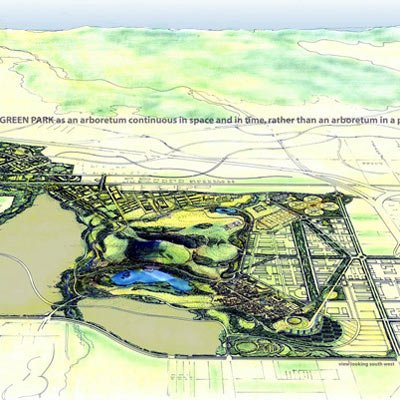
limit our work to one area. We believe architecture exists from an
urban-landscape scale, to residential, down to the detail of a chair."
But like most people the world over, they believe a
house is a place of memory. "Right now, it's new and like any new
relationship we're still discovering its complexities," says
Pirzio-Biroli. "In time, it will acquire the patina of familiarity and become a
home."
Victoria Medgyesi writes about architecture and
lifestyle trends. Benjamin Benschneider is a Pacific Northwest magazine staff
photographer. |